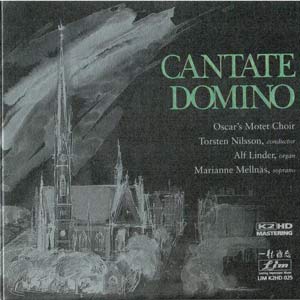
Cantate Domino – Oscar’s Motet Choir, Torsten Nilsson
Originally recorded in 1976 for the Swedish Proprius label, Cantate Domino by Oscar’s Motet Choir under the direction of Torsten Nilsson has become one of the classic reference recordings in the audiophile world. Recorded at Oscarskyrkan in Stockholm by engineer Bertil Alving, the album combines choir, organ, soprano and brass with the natural acoustic of the church playing an essential role in the recording.
The original sessions took place on January 23–25 and April 29, 1976. Rather than relying on a complex multi-microphone setup, Alving used a remarkably simple recording approach involving a Revox A77 and a pair of Pearl TC4 microphones. The result is a recording in which the performers and the surrounding acoustic remain closely connected.
The album has appeared in several formats over the decades, including the 2003 Proprius Hybrid SACD. This version is a high-resolution transfer produced to the 2xHD standard; it was released digitally in 2021 and is sourced from the original analog recording. The 2xHD version is created from the analog master and is available in various high-resolution formats.
Listen to high quality music at https://audiophilemusic.io where you can enjoy music and buy your favorite album.
TRACK LIST

- Label2xHD, Proprius
- CountryUS
- Release date1796/2021
- GenreClassical
- FormatDSD512 2ch & SACD-ISO 2ch & Flac 16bit/44.1kHz
Sound Quality
The defining characteristic of Cantate Domino is not simply detail, but space.
The church acoustic surrounds the choir and instruments with an unusually natural sense of air. Voices do not appear as isolated points between the speakers; they seem to exist within the same physical space as the organ and brass.
The tonal balance is remarkably convincing. The organ provides a deep foundation without overwhelming the choir, while the soprano retains clarity and presence in the upper midrange. Female voices remain focused without becoming thin or artificially bright.
The recording also demonstrates excellent dynamic scale. When the organ, choir and brass rise together, the presentation can become physically powerful while retaining the sense of the church surrounding the performance.
The 2xHD transfer preserves this character particularly well. Comparisons published by The Absolute Sound found the DSD 2x version especially impressive, with improved smoothness and preservation of choral texture compared with the 192/24 version.
Audiophile Listening Experience
Cantate Domino is best experienced at a realistic listening level, where the relationship between direct sound and reverberation becomes easier to appreciate.
The soundstage is not artificially wide. Instead, it has a convincing sense of depth, with the choir occupying a defined area while the church continues beyond the immediate position of the performers.
This is where the recording becomes especially useful for evaluating a high-end system. A capable system should reproduce not only the voices and instruments, but also the air surrounding them.
Listen to the decay after a sustained organ chord or the final notes of the choir. The performance does not simply stop when the musicians finish playing; the acoustic continues for a moment, gradually revealing the dimensions of the building.
This natural decay is one of the reasons Cantate Domino has remained useful as an audiophile reference for decades. The recording allows listeners to judge depth, imaging, tonal balance and the ability of a system to reproduce a large acoustic without turning reverberation into artificial ambience.
Reference Tracks
Cantate Domino — The opening track is the essential starting point. Organ, choir, trumpets and trombones combine to create a large-scale presentation. Listen for the organ’s foundation, the positioning of the choir and the way brass energy expands into the church acoustic.
Frojda Dig, Du Kristi Brud — A useful track for evaluating vocal texture and the natural relationship between voices and reverberation. The soprano passages should retain clarity without sounding detached from the surrounding acoustic.
Lullaby — A quieter performance that reveals the recording’s sensitivity to vocal tone and small spatial details. Listen for the texture of the soprano and the gradual decay surrounding the voice.
Jul — Particularly useful for evaluating the organ. The instrument should have weight and depth, but individual notes should remain controlled rather than turning into a generalized low-frequency rumble.
Zither Carol — The choir provides a good test of separation and tonal consistency. Listen for whether individual vocal lines remain intelligible while the ensemble still sounds like a unified group.
Best Edition / Mastering
The history of Cantate Domino is part of its appeal. The original 1976 Proprius recording was released long before high-resolution digital formats existed, yet its recording quality has allowed it to survive numerous format changes.
The 2003 Proprius Hybrid SACD became an important digital edition, while the later 2xHD transfer takes the original analog source into modern high-resolution territory. The 2xHD version is therefore best understood as a new high-resolution presentation of the historic recording rather than a new recording or a DSD-native production.
For listeners focused on high-resolution digital playback, the 2xHD edition is particularly attractive because it preserves the most important quality of the original: the relationship between the performers and the acoustic space.
Audiophile Verdict
Cantate Domino remains an exceptional example of how a relatively simple recording setup can produce a remarkably convincing musical space.
Its greatest strength is not exaggerated detail or spectacular bass, but the natural connection between voices, instruments and architecture. The organ has scale, the choir has physical presence, and the church acoustic provides a sense of depth that few studio recordings can reproduce convincingly.
The 2xHD edition gives modern high-resolution listeners an opportunity to experience this historic Proprius recording in a format that emphasizes its spatial information, tonal naturalness and dynamic character.
For audiophiles, Cantate Domino is especially valuable as a reference for soundstage depth, vocal imaging, reverberation, tonal balance and large-scale acoustic realism. More than simply a famous audiophile recording, it remains a compelling demonstration of what can happen when excellent musicians, a sympathetic acoustic and a skilled recording engineer are allowed to work together without unnecessary complication.