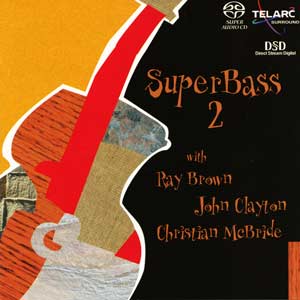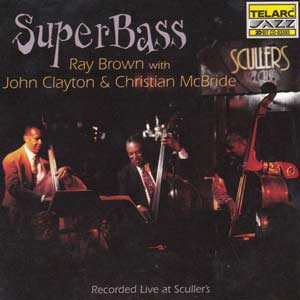
SuperBass 2 – Ray Brown, John Clayton, Christian McBride
SuperBass 2 is a remarkable live jazz recording built around an unusual idea: three acoustic bass masters sharing the entire musical foreground. Ray Brown, John Clayton and Christian McBride were recorded at the Blue Note in New York in December 2000, with Telarc capturing the performance in Direct Stream Digital. The result is both a musical conversation and an unusually revealing test of bass reproduction.

Sound Quality
The defining quality is bass texture rather than sheer low-end weight. Each player has a recognizable tone, attack and sustain, and a good system should make their positions easy to follow without turning the three instruments into one oversized bass. The live club acoustic adds useful depth, while the audience and room ambience give the recording a convincing sense of scale. Transients are clean, and the upper harmonics of the basses remain important to their individual character.
Audiophile Listening Experience
This is an excellent disc for checking low-frequency definition, timing and stereo placement. The bass should sound deep and physical but never slow or blurred. Listen to how plucked notes develop, how resonances decay, and how the musicians move between ensemble playing and solo passages. The live setting also makes it possible to judge whether a system can reproduce both intimate detail and the atmosphere of a crowded jazz room.
Reference Tracks
“Mysterioso” is useful for following the interaction of the three basses and their different attacks. “Papa Was a Rolling Stone” brings stronger rhythmic energy and percussion, while “My Funny Valentine” is more revealing of tone, space and subtle dynamics. “Taco With a Pork Chop” is another good choice for judging bass articulation and live ambience.
Audiophile Verdict
SuperBass 2 combines exceptional musicianship with a recording concept that exposes the character of a hi-fi system very clearly. It is not simply a demonstration of deep bass. Its real value is the ability to separate pitch, texture, attack, decay and spatial position within an instrument that is notoriously difficult to reproduce convincingly. For audiophiles, it remains an engaging reference for bass control, imaging, dynamics and live realism.